Tomer Ashuach
Researcher at Technion – Israel Institute of Technology

I’m a PhD student at the Technion, advised by Prof Yonatan Belinkov and supported by the VATAT Excellence Fellowship in AI. My research focuses on the interpretability of language models, with particular emphasis on uncovering their internal mechanisms and understanding how knowledge is acquired and can be unlearned. Currently, I am also a research intern at Google Research, working with Jonathan Herzig.
Research Interests
- Interpretability in LLMs
- Knowledge and Unlearning in LLMs
- AI Safety and Alignment
News
| Aug 2026 | Giving a talk at the University of Michigan Summer NLP reading group. |
|---|---|
| Jul 2026 | Started a research internship at Google Research, under Jonathan Herzig. |
| Jul 2026 | Presented CRISP and Privileged Knowledge orals at ACL 2026 in San Diego. |
| Jun 2026 | Invited Talks Gave invited talks at MIT (Jacob Andreas), Brown (Ellie Pavlick), the Kempner Institute at Harvard (PRISM reading group), Boston University (Aaron Mueller), and Northeastern (David Bau). |
| Apr 2026 | Attended the Citadel GQS PhD Colloquium in New York. |
| Aug 2025 | Started a research internship at IBM, under Liat Ein-Dor. |
Selected Publications
2026
- ACL 2026 (Oral)
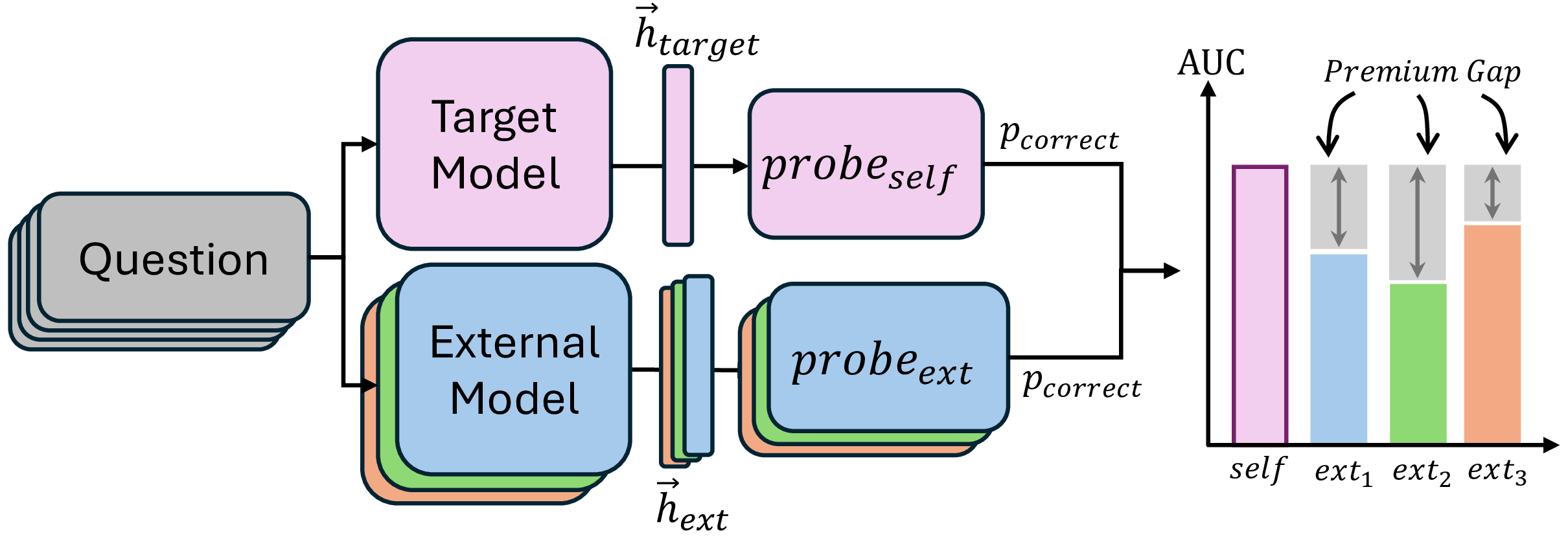 In Proceedings of the 64th Annual Meeting of the Association for Computational Linguistics: ACL 2026, Dec 2026We explore whether large language models possess privileged internal knowledge about their own correctness, analogous to human introspection. By evaluating models on conflicting predictions, we discover that LLMs exhibit a domain-specific intuition for factual knowledge tasks that external observers cannot access.
 - ACL 2026 (Oral)
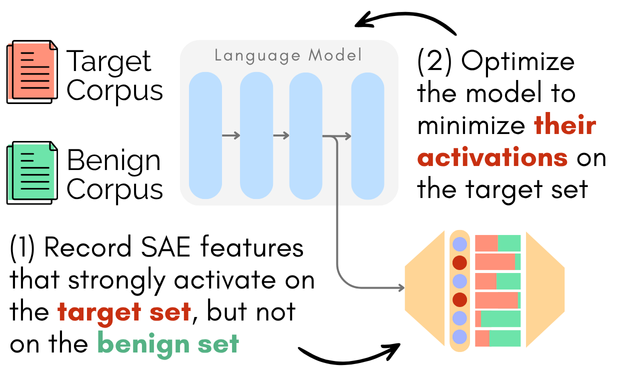 In Proceedings of the 64th Annual Meeting of the Association for Computational Linguistics: ACL 2026, Jan 2026We introduce CRISP, a parameter-efficient method leveraging sparse autoencoders to achieve persistent concept unlearning in LLMs. By automatically identifying and suppressing salient features, CRISP successfully removes harmful knowledge while maintaining model utility.
2025
- ACL Findings 2025
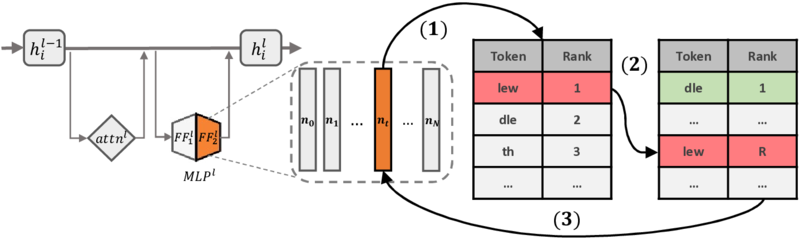 In Findings of the Association for Computational Linguistics: ACL 2025, May 2025We propose REVS, a non-gradient-based method that unlearns sensitive information from language models by identifying and modifying a small subset of relevant neurons. REVS achieves robust unlearning and resists extraction attacks while preserving the model’s underlying integrity.